False Idol: Worship in the Age of Avatars
The last Wednesday evening of April brought a crisp chill to the air, carrying a hazy glow that settled over Central London’s rush hour traffic. At Somerset House, resident artist Sian Fan’s exhibition False Idol unfolds like a fever dream stitched together from mythology, gaming culture, and digital nostalgia. Developed through the studio’s programme, Somerset House Studios, the exhibition explores how spirituality and worship continue to thrive in a hyper-mediated, consumer-driven world—not through ancient relics or sacred architecture, but through TikTok tarot readings, Pokémon iconography and the aesthetics of online construction.
Tucked away in Somerset House’s New Wing, False Idol carries an eerie sense of mythicism that evokes both awe and unease. Suspended against a projection of an artificial night sky, the three sculptural garments drift, hovering between deity, avatar and commercial object. The installation’s ethereal staging—figures floating above viewers, illuminated in synthetic moonlight—creates a striking separation between the viewer and the sense of the idealised body, evoking a sensation that is simultaneously celestial, yet unnervingly artificial.
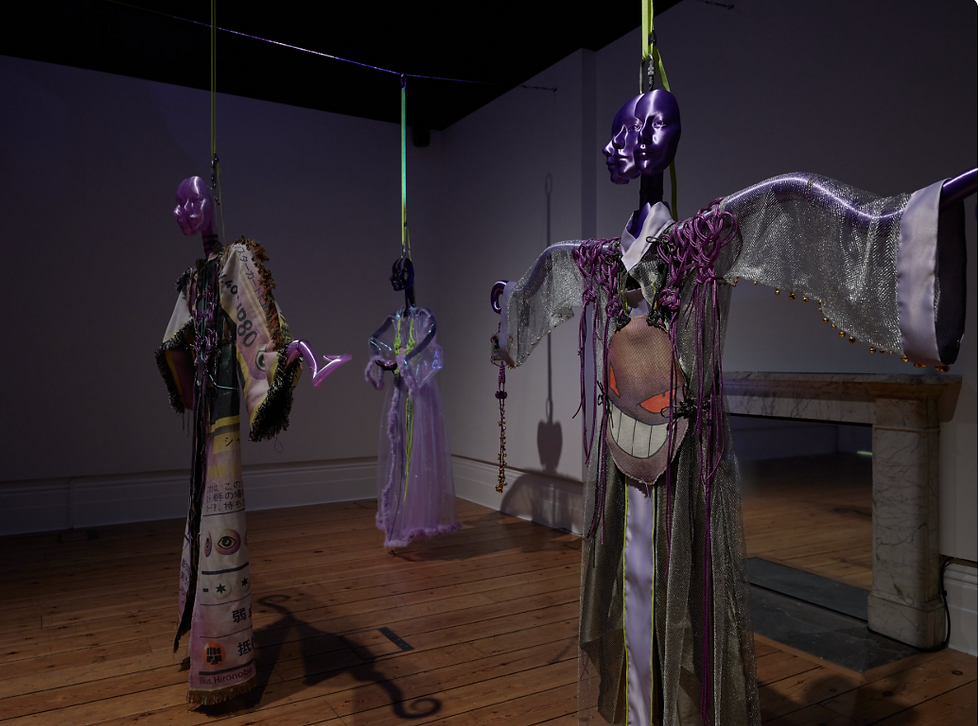
Each garment is an intricate assemblage of cultural references. Although they each possess a distinct identity, they further contribute to a larger mythology of meaning. One of the most compelling garments is the sleepwear-inspired look: sheer, iridescent and almost ghostly in its femininity. Its holographic fabric recalls the exaggerated glamour of the bathrobes in Death Becomes Her, balancing whimsy with something faintly uncanny. Elsewhere, armour-like constructions combine references to samurai attire, medieval chainmail and video game aesthetics, with woven Pokémon imagery embedded into the surfaces. The layering of references, from Mortal Kombat’s Chun-Li to Final Fantasy, creates a deliberate pastiche of fantasy archetypes and internet-age symbolism.
Materiality is also central to the exhibition. The garments are constructed from overtly synthetic and commercial fabrics such as holographic textiles, industrial plastics and artificial mats, deliberately rejecting traditional notions of authenticity, provenance or artisanal purity. In doing so, the work suggests that contemporary mythologies are no longer inherited solely through historical artefacts or religious iconography. Instead, they emerge through the aesthetics of mass media and digital culture as TikTok tarot readings using Pokémon cards become as symbolically charged as ancient talismans; video game avatars acquire the status of contemporary deities.
The motif of the number three—expressed through the three faces on each of the three figurines—echoes mystical numerology and symbolic trinities, reinforcing the exhibition’s preoccupation with ritual and systems of belief. The repeated 3D-printed replicas of the artist’s own face further intensify this effect, transforming self-image into deity, avatar, and digital idol.

These visual strategies are further underlined by a meditation on diasporic identity and digital embodiment. Drawing upon her mixed Chinese-British heritage, the artist explores the unstable terrain between cultural inheritance and virtual self-construction. References to anime, 1990s East Asian popular culture and early gaming aesthetics lend the exhibition a distinct millennial nostalgia, becoming a vessel through which questions of hybridity, objectification and technological intimacy are explored. This logic is extended into the forthcoming live activation of the ritual garment on May 27th, performed by the artist using aerial silks. As concealed elements of the garment are gradually revealed through movement and sound, the body becomes both medium and spectacle, suspended between human and idol, physical and virtual, sacred and constructed.

In an age where digital culture permeates every aspect of our lives, False Idol questions how authenticity is constructed through virtual identities, online presence and image perception. The exhibition reflects a wider social condition in which identity is constantly mediated through digital and consumer aesthetics, blurring the boundaries between genuine and fabricated. By transforming video game iconography, internet symbolism and synthetic materials into objects of reverence, the work suggests that contemporary systems of belief are no longer rooted in religion or tradition. Instead, they are shaped by platforms and digital spectacle. In doing so, the exhibition hauntingly captures the complexities of navigating the ubiquitousness of the internet, where self-curation and virtual embodiment intertwine with both personal identity and collective meaning.
Ultimately, False Idol articulates not a rejection of technology, but an acknowledgement that spirituality now increasingly manifests through digital and consumer forms. Myth persists through hyper-connectivity, as digital culture becomes a medium for ritual, transcendence, and self-construction. As avatars and fandoms intertwine with performance and transformation, digital identity itself becomes a site of contemporary worship. Framed through art, this logic produces a haunting, visually rich installation which lingers long after leaving the space.
False Idol is free exhibition at Somerset House until 12th July 2026
Feature image: Courtesy of Dan Pluck and Dan Pluck
Edited by Madeleine Rick, Art Editor


Comments