Henry Birdsey on Building the World of Old Saw

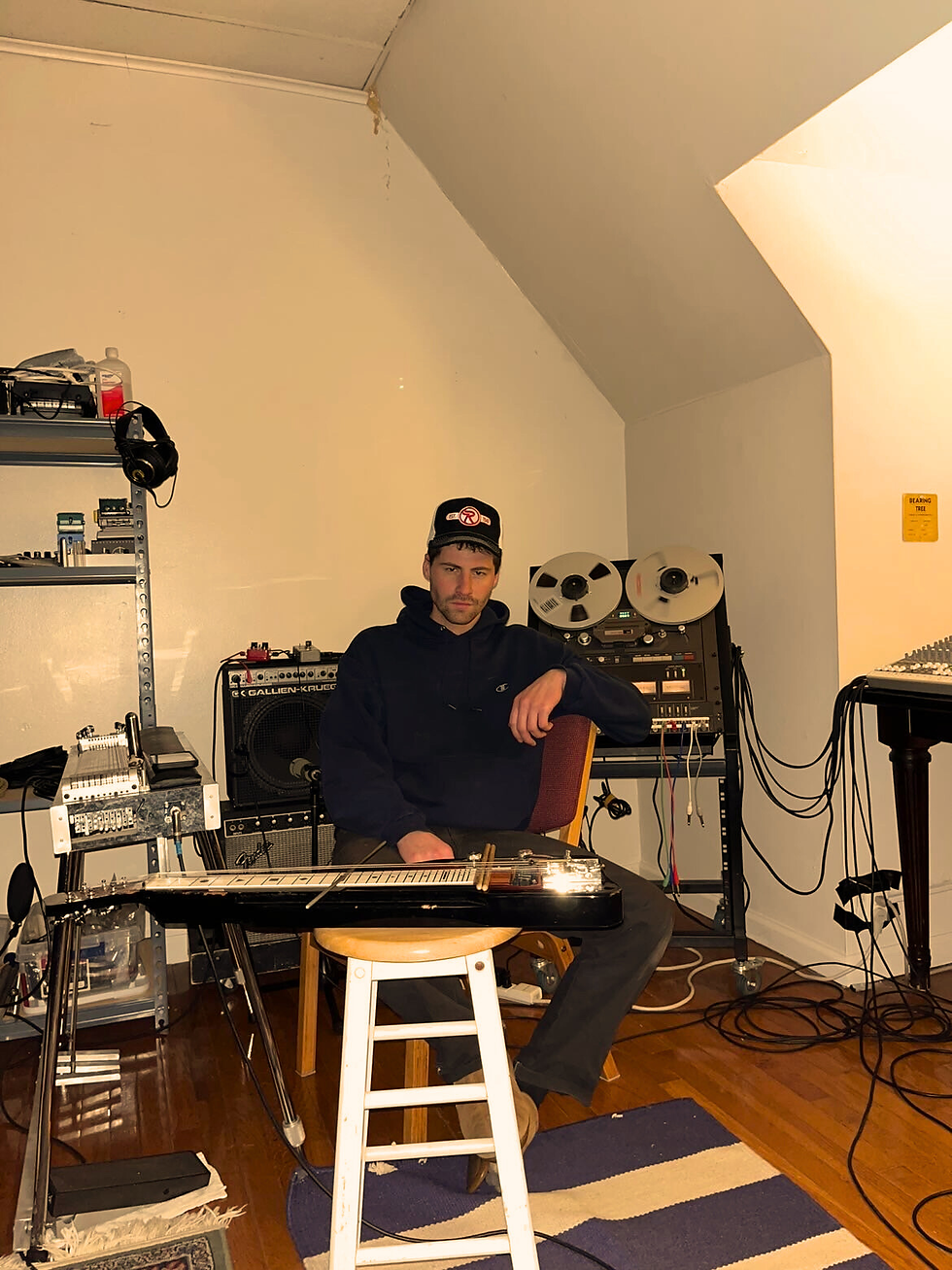
Led by Vermont based composer, multi instrumentalist, and recording engineer Henry Birdsey, Old Saw operates less like a traditional band and more like a quietly shifting collective. Described as a ‘network of New England string pluckers, organ drivers and bell ringers,’ the project brings together Bob Driftwood on banjo, Ira Dorset on fiddle, Rev. Clarence Lewis on pipe organ, Harper Reed on resonator and nylon string guitars, Ann Rowlis on orchestral bells, and Birdsey himself on pedal and lap steel.
Birdsey’s relationship with sound began early. The first instrument he played was harmonica at around five or six years old, something he recalls as deeply entrancing. He could wander for hours playing it, long before realising that sound itself could be shaped into composition. That early fascination still underpins his approach today. For Birdsey, music carries a strange gravity, something both haunting and magnetic. As he puts it, sound is made of invisible pressure waves that surround us and are impossible to escape.
Over time his compositional approach has also shifted. Where he once thought in terms of building and layering ideas through addition and expansion, Birdsey now works increasingly through subtraction and erasure, carving away at a piece until only what is essential remains. That philosophy can be heard across Old Saw’s catalogue. Their 2021 record Country Tropics unfolds across four long pieces that blur folk, country, ambient, and drone into patient meditations on the American landscape. One of its tracks, ‘Dirtbikes of Heaven, Grains of the Field,’ has since reached more than half a million streams on Spotify, quietly introducing the project to a wider audience.
In October 2025, the group returned with their fifth full length album, The Wringing Cloth. Across twelve tracks, Old Saw continues to refine its slow moving, spacious language, where fragments of folk instrumentation stretch outward into something both intimate and vast.
We spoke to Birdsey about the origins of Old Saw, his evolving approach to composition, and the ideas behind their latest album, The Wringing Cloth.
How did Old Saw first come together as a band?
In the winter of 2021 I bought a used reel-to-reel tape machine and needed a new project to put it through its paces and experiment with it. I hadn’t had a really well functioning 1/4” machine in a long time so I was just on an analogue recording bender for a year or so, and Old Saw became the project I used for that. I had some friends from around Vermont and New England contribute things but most of them didn’t want to play shows or do anything public, so I sort of became the centrepiece by default, since I was already out and about touring with Tongue Depressor and other projects.
Who are the composers, musicians or even non-musical influences that most consistently shape how you hear and imagine sound?
I’ve been listening to this record a lot lately called The Wind Harp – Songs from the Hill, which is a collection of recordings of a thirty foot tall aeolian harp built out of wood and steel by Ward McCain in the 1970s in Chelsea, Vermont. To me, the wind is the perfect ideal of how to play an instrument, with no projected identity, just some kind of unlearned force and softness.
I listen to a lot of music as a fan, but most influences lately come in non-musical forms – books, topographical maps, small objects. The book Names on the Land by George Stewart was one. As well as The Collected Songs of Cold Mountain translated by Red Pine, and An Elemental Thing by Eliot Weinberger. Thomas Merton’s work has been present lately as well. Maybe it’s because I make music without words, but writing tends to be the most direct influence, at least recently.
You’ve spoken about learning to compose through erasure and subtraction rather than accumulation. When you’re starting a new piece, what’s the first decision you make, and how do you know what doesn’t belong?
It’s different depending what project I’m doing. I make very different music under my own name than what Old Saw does as a group, but generally no matter what I’m working on, I record much longer takes than I know I’ll use, and then spend a lot of time mixing and cutting things down. Part of it is just the nature of analogue recording – I’m tempted to keep playing as long as the tape is rolling in front of me and it becomes hypnotic. There are some techniques for creating gaps and fractures, like doing overdubs without monitoring the previously recorded tracks. After a couple passes of that, you get a kind of disjointed quality that can’t be done by intentionally trying to play disjointed. There’s a lot going on in the music at times, so the trick is to weedwack my way back through it and be decisive and ruthless about cutting things and not get too precious. Old Saw began as a very studio-oriented project just because I love tracking music to tape, but I have to be equally devoted to editing too.
‘Dirtbikes of Heaven, Grains of the Field’ has surpassed half a million streams on Spotify. What does it feel like to have such a piece connect with so many listeners, especially as part of your first album?
It’s hard to say. I don’t think about it much. Musicians are the last ones to understand how their music works in people’s lives, and on top of that, streaming is a weird and concealed system for consuming music. It’s very different from someone coming up and buying a record at a show, because then you have a sense of who they are, where they’re from, you exchange words and you know that you’re actually making music for someone specific rather than a numbered audience online. I get funny glimpses into that online world though when people send me clips of my music being used as a soundtrack for a fly fishing expedition or a homemade perfume advertisement or something like that, but it’s too far away to feel one way or another about it. Even if the music is used as wallpaper, I guess I’m glad it has a life somewhere.
I’m more interested when people email me to tell me really specific crazy personal experiences, how and where they listen to the music, things that it dredges up, family, travel, nightmares, memories, lost things. Sometimes it even verges on imaginary fan-fiction type of stuff which is interesting. Records have a trajectory that’s independent from anything I might try to control so I just sort of let it go. I used to be distracted and confused by the words people used to describe my music but I’ve learned that my job is just to make it and not define the terms of its existence.
Looking back at Country Tropics, what do you feel that record revealed to you about the American landscape or about your own compositional voice?
Country Tropics came from some place I couldn’t go back to or explain if I tried, maybe because it was born as a purely functional experiment without any intention of release. I can’t speak for anyone else involved, but my own memory is blacked out, which is unusual. I tend to have an archival memory of details about how records were made, but I remember very little about how that one came together. I think the more abstract and droning elements probably came first and then whatever formal structure there is grew around that. I definitely remember really spending a lot of the time on the mix.
With the Old Saw project, I started to understand that all the different music I make in various projects is one long-form musical object that functions more like a mosaic than a painting – something composed of many small iterations and variations of itself, and it changes shape depending on the distance you view it from. A project and a name is just a vessel, a way of filtering. Even though to me the music I make is all one continuous body, it’s interesting that certain projects reach different people, and that there are people who might love Old Saw but hate my solo music, or vice versa. That disconnection can be uncomfortable sometimes but it’s just the nature of doing different things.

In terms of landscapes, I think there’s a cliche in music of trying to evoke specific American landscapes (the desert west, for example) as a complete stand-in for “America” at large, but in truth there’s just this enormous and granular expanse with no boundaries. I try to think about the landscape if we were to look at it one hundred feet or one thousand feet underneath the surface at the dirt, clay, bedrock, oil, without the delineations we inscribe into it on the surface. One thing that touring exposes is the borderless morphing of regional landscapes on a microscopic scale. Language habituates us to misleading broad ideas about how one place turns into another – from rustbelt towns, to cornfields, to plains, to mesas, etc. But touring at a daily crawl takes you to the surreal and undecorated corners of places immediately, and you realise that people live everywhere and carry on in their own strange geographic ways somehow. You have to get off the highways and out of the car though.
What emotional or conceptual thread were you most intent on holding onto while making your latest album The Wringing Cloth?
I guess I’m trying to solve a two-part riddle for myself, one that will probably make for life long work. On one hand, I’m trying to make music that takes off and lives in such a way that I forget my own involvement in making it. To that end, I see my job as a musician like a seasonal temporary hire. I just step in during a certain phase in order to translate one thing into another and then let it fly. My name isn’t important. The dates don’t matter. I don’t want credit or recognition. I want the imagery of the music to eclipse and wash away my identity and connection to it. I admire the anonymity of long gone composers of sacred music who gave us the gift of that music without the added tax of ego.
The other component of the riddle is that the music needs to live in a place and be from a place. It doesn’t have to be about something necessarily, but it should illuminate a territory beyond itself and its construction. I don’t want a perfect translation either though. I want to be able to see the lines that got erased and drawn over, with off-kilter and missing elements. Obviously I don’t always succeed in doing this, it’s just what I aim for. I recorded all this music in the various houses I and my friends have lived in, never in a studio, because I like to hear the sound of those places that I’ve been. It’s a physical practice as well as a conceptual one I guess.
If you were to collaborate with another artist, who would you choose?
Scott Walker.
Where do you see Old Saw heading in the next?
There’s some dust that needs to settle right now. We’ve made four records in the last five years and never played a single show, which is a bizarre mode of operation. There’s been a lingering question of whether it would be best to just let Old Saw exist as the body recorded music and disappear, but there are also ideas being thrown around of possibly touring. Playing live is something we only recently became open to and need to figure out how to do it in a way that upholds various promises to ourselves.
Listen to Old Saw on Spotify, SoundCloud, and Apple Music and follow him on Instagram to keep up to date.


Comments