Fits Like A Glove: C'est Jeanne Lands In London

Once a chandelier shop dating back to the mid-1800s, the ‘Light House’ finds itself nestled between Soho and Oxford Street as one of London’s most unique fashion stores. Behind its grandiose double glass doors lies a world that feels timeless, transporting visitors away from the chaos that is central London. Every inch of the interior is dedicated to showcasing independent designers from around the world-varying in style, craft, and medium. With its commitment to championing artisans within the fashion realm, the ‘Light House’ provided the perfect setting for C’est Jeanne’s temporary London pop-up ahead of the city’s Fashion Week.
C’est Jeanne is an independent luxury fashion house specialising in fully hand-made gloves, working across a variety of fabrics, including mesh, silk and, most recently, leather, which are often elevated by the incorporation of elaborate hand-stitched embroidery, turning the fashion accessory into an intricate art piece. Established in 2017, designer Jeanne Hermans operates C’est Jeanne entirely in the Netherlands, having taken the brand’s name from her French familial heritage; translating as “This is Jeanne", the name is both a reference to her roots as well as the personal approach that defines the brand in both design and craftsmanship. As the fashion house approaches its 10-year anniversary, C’est Jeanne has undergone a truly remarkable evolution: from a limited project developed in Hermans' bedroom in her parent’s house, to an internationally recognised label housed in its own studio with revolving interns keeping techniques of the craft alive under the supervision of Hermans.
The label’s distinctive gloves have cultivated a quarter of a million followers on Instagram, with its designs being featured in magazine covers such as Vogue India, and have been photographed to be worn by some of the world’s most recognisable names such as Anne Hathaway, Miley Cyrus, and more recently Arianna Grande, whose arms were seen covered in custom mint-green mesh gloves adorned in embroidered silk dragonflies for the Swarovski capsule collection. Yet, despite its large following and the stars that plaster its long list of clientele, C’est Jeanne has managed to maintain its identity as an accessible, independent fashion brand. This is particularly evident in the brand’s custom couture, which is created through an incredibly intimate and personal process; customers are encouraged to enquire directly through the website about each meticulous stage of the craftsmanship, offering a rare level of transparency into the making of each pair of gloves.
C’est Jeanne extended this sense of accessibility to its global consumer base with a two-day pop-up on the top floor of the Light House, which is typically closed off to the public. Hermans and her sister, who oversees much of the brand’s social media and photography, welcomed each customer personally – even commending visitors for making it through the four flights of stairs to reach the illusive attic. The intimate space had been transformed into a paradise for glove lovers, creating an experience that felt less like a traditional retail appointment and more like a personal invitation into the glamorous world of C’est Jeanne.
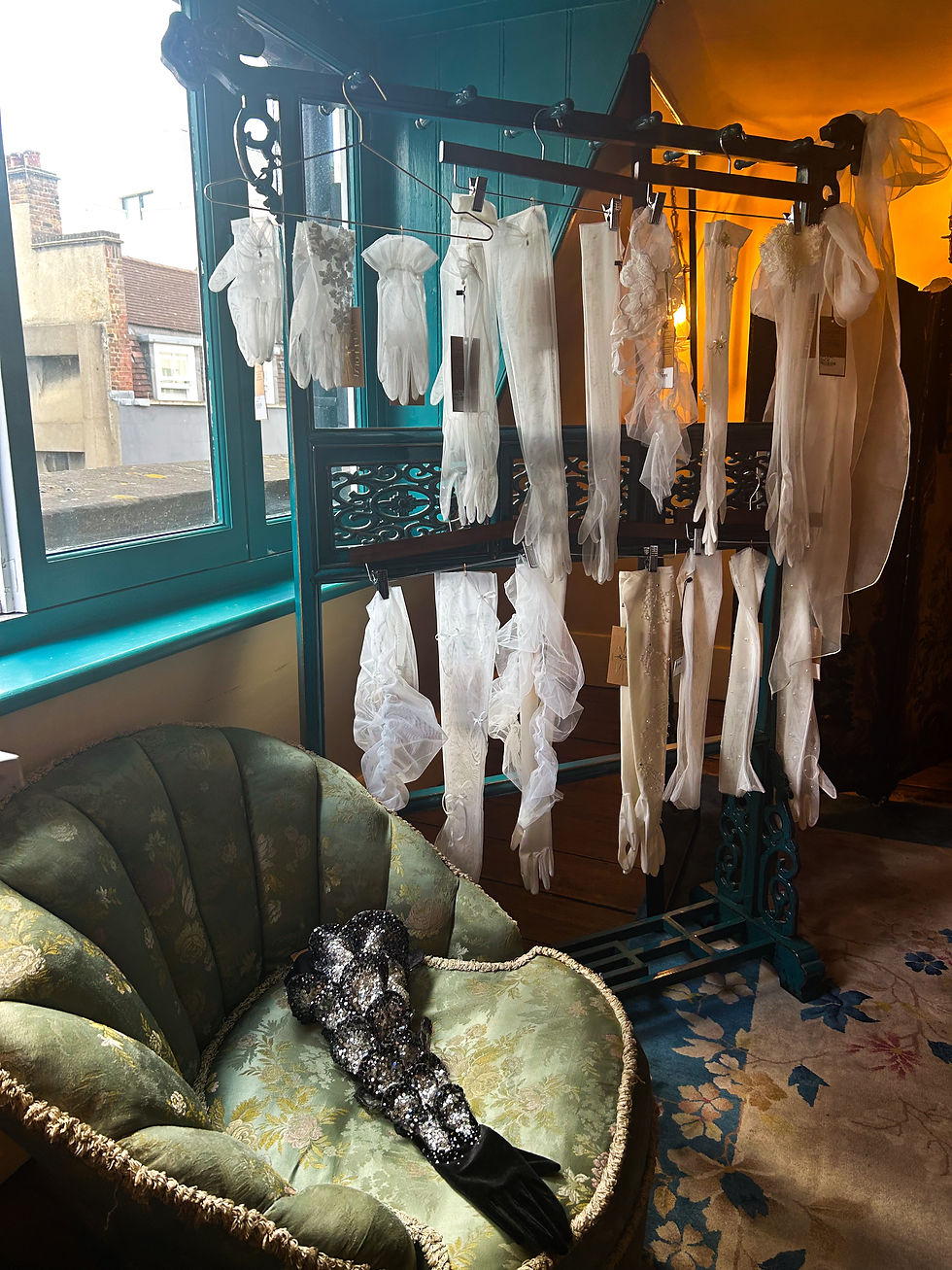
Against the attic’s sole window (and primary source of light) stood a sage-green wooden clothing rack, yet its rails were draped with an array of white gloves rather than clothes. They cascaded from long to short, from opaque to sheer, from embellished to understated. This was C’est Jeanne’s bridal collection. Ribbons arranged into delicate bows; pearls caught in the sunlight; intricate lace trim the ends. It was impressive to observe how each pair of gloves offered its own interpretation of bridal personalities, whether that was the bride who was romantically demure or the bride who was gleamingly opulent. Regardless, the collection allows brides to enhance the elegance of their wedding day wardrobe with another accessory to wear on their hands that isn’t just the ceremonial ring.
The rest of the attic was devoted to gloves from C’est Jeanne’s couture collection, displayed hung on racks or laid flat across tables and shelves. Each corner of the room revealed designs dramatically different from the pair beside them: shiny lycra, embroidered velvet, and ruffled mesh – the variation was nothing short of impressive for an accessory so often overlooked within an ensemble. Yet, C’est Jeanne’s ambitious creativity places their gloves firmly at the centre of attention, turning them into the star of the show when worn with any outfit. Like the bridal collection, the couture collection truly seemed to have a design for everyone – nothing seemed out of bounds stylistically. One rack featured an extensive selection of leather gloves, all of which differed in length and style whilst combining practicality with the same elegance maintained throughout the designs crafted from more delicate materials. Although, one of the most striking designs in the entire room was the multiple pairs of gloves partially covered in protruding butterflies; they were quite difficult to overlook, thanks to the soft movements of the silk wings that created the enchanting illusion that they were not only real but also alive.
This whimsical fascination with nature was a recurring theme throughout many of C’est Jeanne’s embroidered designs: beads made to resemble tiny ants appeared to crawl across red velvet globes, while leaves seemed to grow organically from brown leather. Every colour palette had also been carefully considered, including a range of skin tones. The gloves that incorporated nude mesh were particularly captivating, especially when worn against a matching complexion. In fact, the skin-toned mesh blends so seamlessly into the wearer’s skin that Hermans couldn’t help but recount the comments she receives accusing the brand of using fashion tape to secure the accompanying embellishments to the skin, when, in reality, the illusion is simply the result of masterful craftsmanship.

Ultimately, C’est Jeanne’s showroom at the ‘Light House’ in London presented a captivating glimpse into a niche fashion craft, one that the brand has successfully turned into its own canvas for imagination and self-expression - a creativity that is often reserved for other garment types and accessories. C’est Jeanne’s dedication to not limiting itself in design and material makes the brand even more compelling, and luckily for Strand Magazine, Hermans offered her time to answer our questions about her journey in creating such a unique fashion label, her own creative ambitions, and what she hopes the future holds.
Couture glove-making is quite a niche within the fashion world, particularly when you first started the brand. How did you find the resources and knowledge needed to master such a specialised craft?
Jeanne Hermans: Glovemaking really is a very niche craft, which is actually one of the things that drew me to it. I started glovemaking during my studies at the Master Tailor Institute in Amsterdam, during which I was looking for a challenge alongside my other schoolwork. Glovemaking was mysterious to me, precisely because there is not much out there – you can find countless videos on how to make a skirt or blouse, but not so much about making gloves. I started with a book that was given to me by one of my teachers, which had a small section about glove patterns. From there I started working out my own patterns, adjusting and perfecting as time went on. To perfect my craft, I tapped into the skills I already possessed as a trained tailor, which I expanded by experimenting with glovemaking.
What has the journey been like, going from sewing every pair of gloves yourself in your parents’ home to now having your own studio and interns whom you can pass the craft on to?
JH: It has been a wonderful journey, and actually a very organic one. I started this craft not with the idea of building a business from it, but from the perspective of learning and mastering this art form, which at first was just for myself. Slowly, as I started posting on Instagram, my audience grew, and I started gaining clients, which over time turned into a business that could sustain me full-time. Two years ago I was able to move from my spare bedroom into a studio in a creative hub, where I have all the space I need to further my brand.
When creating a custom commission, how do you ensure that a client’s initial concept is translated faithfully into the final piece while still retaining your own craftsmanship and creative vision?
JH: Usually, a custom commission is built from both the client’s vision and my years of experience with glovemaking. During the design process, my perspective as a tailor is naturally included, as I can guide my clients on what is technically possible, what will work well on the hand and arm, and how certain materials and details will translate in the final design. I see the process as a collaboration: the client brings the initial idea and their intention behind it, while I bring the craftsmanship and knowledge to develop that idea into something that can be realised into a final design. It is important to me that the final glove still feels true to the client’s original vision while carrying the level of detail and craftsmanship that defines my work as a glovemaker.
Speaking of custom gloves, would you be willing to share your most memorable commission? Did it change the way you approached your own designs?
JH: I was recently commissioned a custom design that came at such a perfect time in my glovemaking journey, and I have been thinking about these gloves ever since. For context, I recently travelled to the Czech Republic to learn how to make leather gloves, and naturally I have been obsessed with deepening my knowledge ever since. Right after this visit, I was asked to create a pair of leather embroidered gloves for a private client. It has often happened to me that right after I learn a new skill, the perfect opportunity arises for me to expand this knowledge even more: Instead of just making leather gloves, I had the chance to make the most beautifully intricately embroidered gloves I could imagine. They were opera-length leather gloves, with teal/turquoise embroidered leaves and flowers. Not only did I think they looked absolutely gorgeous, they were so tactile as well: the soft leather, the way the beads felt, and even the sound they made. This really was a commission I don’t think I’ll ever forget (and in fact I have since started working on a similar design that will be part of my new leather collection!).

Each of your designs is given a distinct feminine name. What inspired this approach, and what goes into choosing the right name for a particular design?
JH: (I love this question!) I started naming my gloves right from the beginning, as I felt they all had very distinct personalities. It started with very classical Italian names like Vittoria, Domenica, Giulia - not only because I love these names, but because I felt they exuded the sensuality and inherent feminine nature of my designs. Since then each and every design has gotten their own name. The way I name them is based on feeling and aesthetic: I take a step back, look at the design, and the name comes to me. This method of naming my designs has really helped me connect with them almost on a human level. I also have designs that are named after clients who have commissioned a pair of gloves, and funny enough, so often I’ll find that their names match the final design perfectly.
You’re now entering the world of leather gloves - what does this transition represent for C’est Jeanne? Does it feel like a new era for the brand?
JH: For me, entering the world of leather gloves feels like I’ve been reborn in a way. There is a huge difference between making leather gloves and making textile gloves, so I’ve had to unlearn certain techniques and relearn the craft from a completely different perspective. It has been challenging in the best possible way, and I’m beyond excited to be expanding into this world. It also feels like such a natural territory for C’est Jeanne to move into. For years, people have been asking me to make leather gloves, so I’m incredibly happy to finally be able to bring them to life. It feels like a new era for C’est Jeanne, while at the same time being the most natural continuation of everything the brand has always stood for. And this is only the beginning. As I’ve worked on my first leather collection, I’m already imagining all the collections and designs that will follow.
You’ve created gloves inspired by some of the world’s most iconic fashion houses, including Dior and Schiaparelli. Is there a specific fashion house you would love to collaborate with if the opportunity arose?
JH: There are a few fashion houses, and particular areas within couture, that I admire immensely: Dolce & Gabbana Alta Moda, Armani Privé, and of course Dior. But if I had to choose one dream fashion house to collaborate with, it would absolutely be Schiaparelli. For me, there is something so unique about the way Schiaparelli brings together bold, experimental design with an extraordinary level of craftsmanship. The pieces are often playful and unexpected, but at the same time they are executed with such precision and attention to detail. I recently saw the Schiaparelli exhibition at the V&A, and it left me feeling incredibly inspired. I would love the opportunity to bring my own perspective as a glovemaker into that world.
C’est Jeanne’s ten-year anniversary is just around the corner. Are you planning anything special to mark this incredible accomplishment?
JH: I can’t believe it’s almost been ten years of C’est Jeanne! This question actually made me think about a promise I recently made to myself: to take more time to celebrate my wins. So often, when I finish a collection or complete an order, I immediately move on to the next thing without taking a moment to appreciate the work that has gone into it. So, rather than simply looking ahead to the next ten years, I want to use this anniversary as an opportunity to really pause and appreciate how far C’est Jeanne has come and everything these ten years of hard work have brought me. A big part of that celebration will also be sharing what I’ve learned along the way. I’ve been working on an online glovemaking course, which is something I’m very excited about because it allows me to share the craft and knowledge I’ve built over the past ten years with a much wider community. In a way, it feels like a beautiful way to celebrate the past while also passing something on to the future.
C'est Jeanne's next pop-up will be in Paris from September 30th to October 4th, showcasing designs that are availble on the brand's website and shown on their official social media pages such as Patreon, Instagram and TikTok.
Edited by Fashion Co-Editor, Simon Nora Dreyfus


Comments