London Film Festival Expanded 2026 Review: The World Came Flooding In

The World Came Flooding In is an XR installation created by Isobel Knowles and Van Sowerwine that recreates lost objects and spaces to tell the stories of those affected by the 2022 Australian floods. Over roughly 30 minutes, the voices of the people who lived through them guide you through their homes: Tom, Marina and Antoinette, who lived thousands of kilometres apart but were united by their experience of the floods.
Once the headset is on, you are invited into each person's space as they describe their experience, while you walk around and interact with parts of their home. As the story progresses, so do the visuals, and you feel like you are living though the events with them. From Tom's apartment you cross the river to Marina's house, and then to Antoinette's studio and home.
The objects in these homes seem ordinary, just like anything you have in your own, and their value only becomes clear once an event like this takes them away. Each person talks through how they worked to salvage their belongings, and the things they reached for first say a lot about who they are. It was endearing to hear how much vinyl records meant in Marina's life, and hear her describe pushing the furniture to the edges of the room, pulling the records out and dancing with guests, while in VR room changed to mimic exactly that.
The Expanded programme at this year's London Film Festival shows new ways of telling stories outside of film, and VR suits these stories well. Where a film asks you to sit and watch, this experience asks you to be present, and hearing someone's story while you experience the visuals and sounds from their point of view adds a more personal layer as the story surrounds you. It was impactful to follow in Antoinette's steps through her house with her son's penguin plush beside you throughout the journey.
The most interesting choice is how the homes, objects and surroundings look. Rather than building a hyper-realistic 3D render, Isobel Knowles and Van Sowerwine made physical miniatures of each home and scanned them using a process called photogrammetry, before scaling them up into the virtual space around you. They worked from floor plans and input from the storytellers, which makes the homes feel cosier than a realistic render would.
Everything is handcrafted, from the miniatures to the way the stories are told, and there is no point where you feel bombarded with information. VR can become an intense experience, especially when depicting tragedies like the flood, so the length of the experience was well crafted and almost felt like walking through a gallery where you are presented with select information about each piece. The story benefits from being told directly from the perspective of those affected, in the spaces they called home.
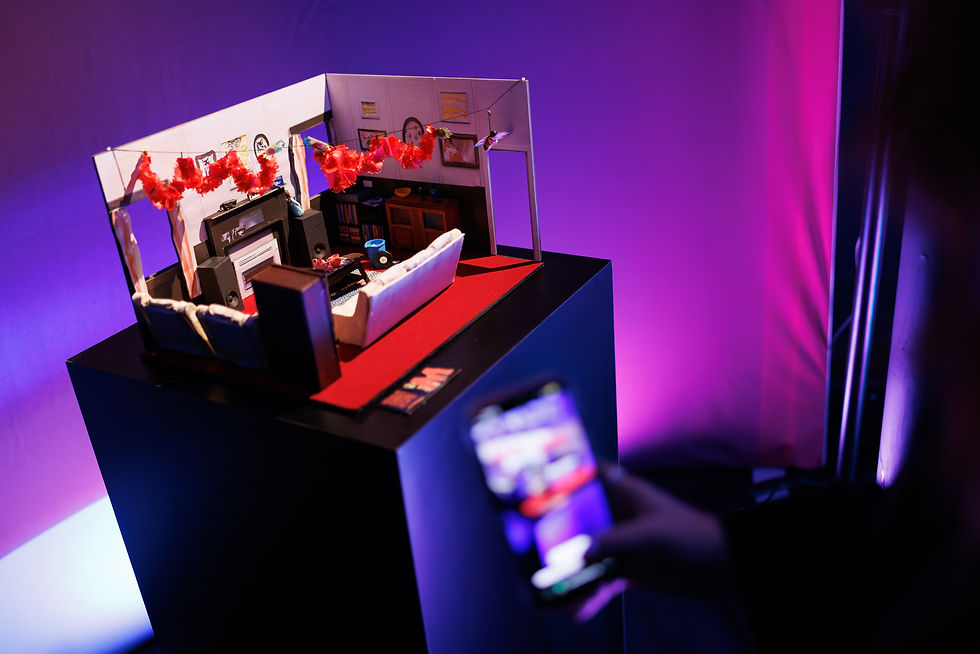
After the VR section, you are invited to look at the miniature of Marina's home in person and scan a QR code to view her hologram in augmented reality as she talks more about the items in her home. The mixed media works well because the items look so small in person, but after the VR experience they carry much more meaning. It connects what you have seen to something tangible.
The World Came Flooding In shows how a story can move beyond the traditional film documentary, by putting you inside the homes of the people telling it. As part of the LFF Expanded programme, it is a strong example of what immersive work can add to the storytelling experience.
The World Came Flooding In is showing at the BFI Southbank VR Lounge, until the 18th October as part of the BFI London Film Festival Expanded programme. More information can be found here.
Written and edited by Joanne Baranga, Gaming Editor


Comments