A Chorus of Refugees: Reviewing “Suppliants of Syria”
When London-based intercultural theatre company, Border Crossings, invited me to the opening night of their latest production about Syrian refugee women, I was immediately invested. I found myself at Hoxton Hall last week eagerly looking forward to a night that would transport me to a sensorily and culturally rich experience of the Levant.
‘Suppliants of Syria’ is a modern retelling of Aeschylus’s Greek tragedy, ‘Suppliants', one of the earliest classics to consider the politics of asylum. The show transplants the traditionally Greek context into the narratives of Syrian refugee women living in Turkey, and quotes directly from Aeschylus’s script to highlight historical references to the Mediterranean, Levant, and the idea of exodus.
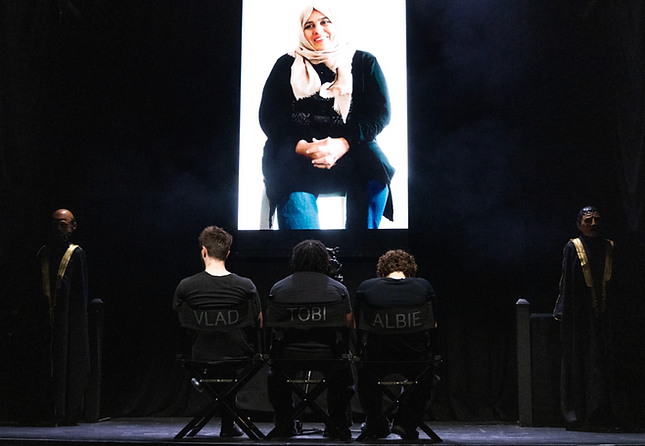
The show is composed of a half-and-half split between pre-recorded testimonials from Syrian women working at a cooperative and live stage acting by actors Tobi King Bakare, Vlad Gurdis and Albie Marber. The juxtaposition works wonders for the concept of depicting the refugee experience as, in real time, the actors on stage seem to represent the Global North’s countries that refugees are typically assimilated into. The women, who appear both in individual confessional-style shots and comprise the Greek chorus, are centred quite literally through a screen positioned in the middle, looking over the stage.
Given the current political climate where global fascism is at a steady rise, Suppliants of Syria felt like an especially pertinent show to attend. It raised important questions of the impact of war on displacement, violence against women living under ISIS, survival and survivor’s guilt, democracy, and immigration. It also approached the intricacies of language and underscored the varying connotations of “refugee” versus “asylum seeker” and the dissonance these labels come with.
The urgent, real-world relevance was all the more pronounced as the live actors recalled events from recent history that pertained to distortions in the world’s treatment of refugees. The headlining image of Alan Kurdi’s little body on the shores of Greece, the 2023 anti-immigration Dublin riot, and the ISIS executions at the Roman Theatre at Palmyra in Syria were all addressed with great care. And yet, the timelessness of the so-called refugee question was apparent all the more in the fact that the show’s parent material, Aeschylus’s Suppliants, was written circa almost 2500 years ago.
What intrigued me about the show was its multimedia infusions, which were a delight to the senses in every way. There was an exhibit of visual art created by Syrian refugees displayed in the hallways leading up to the stage and the theatre show ended with live music from Rama Alcoutlabi, a Syrian vocalist. It was a lovely way to end the incredibly emotional evening with tunes of Fairouz and Palestinian folk songs to keep you company.
It was also an all-round interactive experience, which I thought was quite interesting. I had walked into the show expecting to sit beside my partner in the typical row-style seating offered by theatre shows. Instead, I found myself seated beside new faces around a table laden with the most delicious Levantine food. The element of getting to know someone over a shared meal resonated as a powerful ode to cuisine as a community-building vehicle, and also allowed several Muslim attendees to break their fast right before the show started. In a manner that honoured Suppliants’ Greek roots, the audience was also invited to participate in a mid-show democratic debate as “citizens” who could choose whether or not to permit the refugees to enter.

While I thoroughly enjoyed the show, a few things come to mind that I wish had been done differently. The music, for one, felt amiss at times when superimposed over the videos of the refugee women’s chorus although it felt very fitting for the more violent scenes taking place on screen. In the spirit of centring women’s experiences, I also hoped that of the three on-stage, live actors, at least one would have been a woman. For a show that also challenged the dehumanisation of dispossessed people, I found it a bit ironic that there were sequences of “discreetly” taken footage of survivors of the 2023 Turkey-Syria earthquake included. Although the voiceover suggested that this footage was recorded as it would be valuable to the show, this nonetheless seemed to feed into the questions of consent and exploitation that I felt were raised by Suppliants of Syria itself. It felt like a violation to watch people filmed in such a vulnerable state without their knowledge.
Despite these grievances, I was incredibly grateful for the invite from Border Crossings and left the evening feeling moved in every sense. There were few dry eyes during the show, and much conversation after it, with the opportunity to reflect on our place in the world’s perceptions of asylum-seeking people. If I had been looking for a provocative, immersive experience that would leave me with more knowledge and humility than I had come with, Suppliants of Syria had definitely provided it.
Edited by Grace Mahoney, Theatre Editor


Comments