End Of The World And Hard-Boiled Wonderland At The Barbican
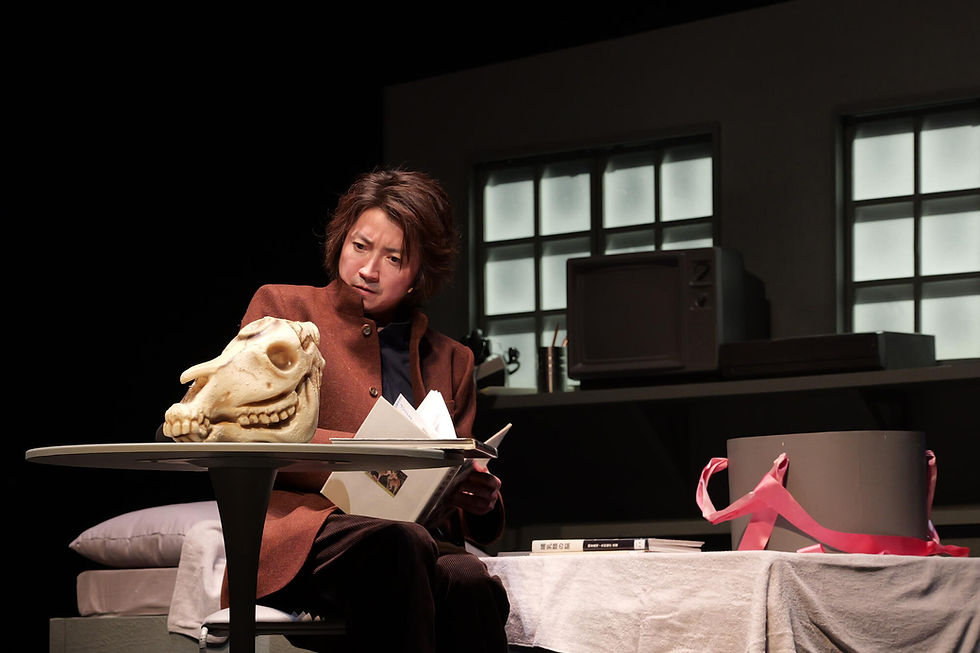
Philippe Decouflé’s staging of Haruki Murakami’s 1985 novel is the first-ever stage adaptation of the book, and this run was its European premiere. It is a story about consciousness and identity, and I’m not sure how else you would stage it than like this: artistic, strange and beautiful. Watching it felt like seeing several art forms at once.
Tatsuya Fujiwara plays Watashi, a “Calcutec” who encrypts information inside his own brain for an organisation known only as the System. Two universes exist in parallel, and he is part of both. One is a Kafkaesque, data-driven Tokyo underworld full of conspiracies. The other is a dreamlike, walled town where the end of the world seems to have already arrived. As the two narratives develop side by side, Watashi discovers a truth that could end his world.
The title of the story asks what the world looks like when it ends, or whether consciousness itself is where it ends. The theatrical adaptation, by Ako Takahashi, maintains that line throughout the story, presenting a captivating dystopian vision of contemporary Japan.
The production is so immersive that it feels closer to a film than a play. The set, designed by K. Ishihara, shifts between settings so fluidly that you never feel like you’re missing the context of a place, and everything is clear even with a relatively small cast. Umitaro Abe’s music and the main musician, Mayu Gonto, give the show the emotional weight that completes the story.
And then there is the range of talent we see. You get ballet, contemporary dance and even singing, plus love, poetry, friendship and moments of humour too. The ballet was my personal favourite. The ballet dancers woven into the contemporary choreography were a beautiful fit for the material, and it made the dreamworld feel properly otherworldly - it was the missing piece for perfection.
The performances are incredible. Fujiwara anchors the show as Watashi, with Misato Morita as the Librarian, Shuntaro Miyao as the Shadow, Miu Tomita as the Woman in Pink, and Kita Komagine as Boku. Haru Fujita (the Small Guy and the Caretaker), Shinya Matsuda (the Big Guy and the Gatekeeper) and Narushi Ikeda (the Professor and the Colonel) balance the work of the main characters, alongside an excellent company of dancers. The whole production was emotional, and with a cast that connected us to the story’s messages perfectly.
Forty years after its publication, the novel still feels perfectly relevant to the time - or even more so now than before. Its concerns with technology and the subconscious feel appropriate in a world dealing with the impact of AI, surveillance and what it means to be human now. There’s a side of the story that asks us: if the government, or other entities, can shape what we do and believe, are our thoughts even our own? Add to that the questions regarding technology and AI in particular, and the play feels more like a very accurate coincidence rather than a fantasy.
Even the dialogues and hidden messages are as poetic as Murakami’s books, and that is the best part for any fan of his work attending the show.
With a story this complex, a production that was performed entirely in Japanese with English subtitles did make it slightly harder to follow at times. But it is also the only way this story could be told. A Murakami adaptation in any other language would lose something special that only he can communicate in his mother tongue.
Fujiwara, known to many from Battle Royale and Death Note, made his Barbican stage debut aged 15 in Yukio Ninagawa’s Shintokumaro in 1997. This is one of his several returns to the Barbican stage since. The production toured Japan extensively and stopped in Singapore before this, its first stop outside Asia. It now moves on to Paris and South Korea.
The Barbican also built a programme around the run: a screening of Battle Royale on 10 October, and on 11 October a rare appearance by Murakami himself, who read from The City and Its Uncertain Walls and spoke with Simon McBurney. A screening of the 2005 adaptation of Murakami’s short story Tony Takitani followed, and it all communicated with a short run for the play!
It was incredible, immersive, emotional, and beautifully designed.The perfect production to launch London’s autumn theatre season.
Edited by Aminata Ndiaye, Theatre Editor.


Comments