In Conversation With Ben Shepherd, Debut Author of 'Blood Drunk'
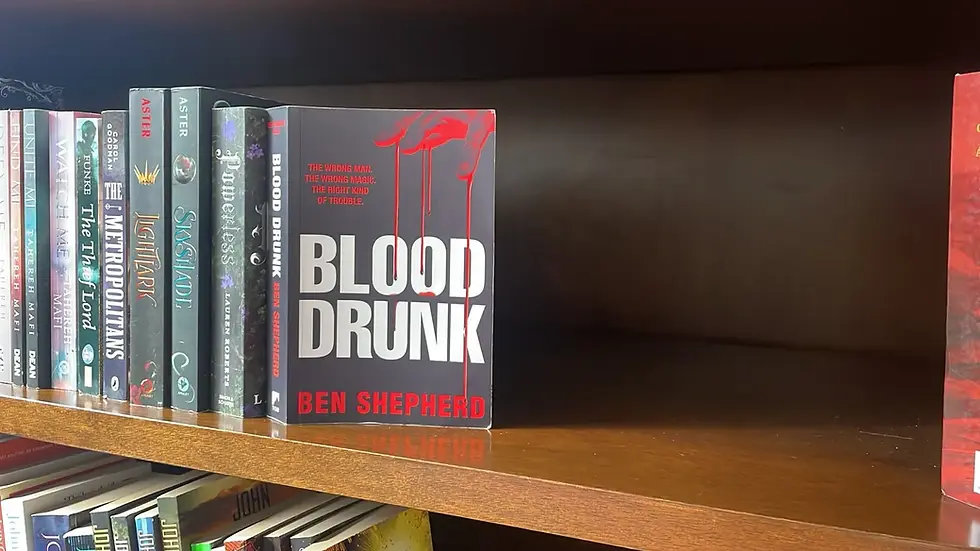
Photo by Daniela Denyer Malo
Blood Drunk is a September new release and Ben Shepherd’s debut novel.
He spent twenty years writing about the world's real monsters. As a diplomat, editor and policy analyst, he worked for the Foreign Office and Chatham House, specialising in conflict and politics in Central Africa. All the while, he was quietly writing a book about vampires, magic and organised crime.
That book is Blood Drunk, published by Tor on September 24th. It follows Freddie Burns, a South London gangster who wants ten pints, a fight and his uncle's fading empire. Then a routine hit goes wrong, and he stumbles into a hidden London where vampires are real and a ruthless power broker keeps it all buried. Freddie can pull magical strength from the death of living things, which makes him the most dangerous man in any room, and one nobody trusts, himself included.
I spoke to Ben about leaving the policy world for fiction, building a completely new world , and what a career as a debut author is like:
The book gives us vampires who wear tracksuits instead of Dracula-coded aristocrats. Where did that image come from, and what were you reacting against in traditional vampire fiction?
I began writing Blood Drunk in 2014 when vampires tended to sparkle, so I suppose I was reacting to that, and I wanted to steer clear of the sexy cleavage-and-billowing-curtains version too – vampirism is repeated and endless murder-cannibalism when you get right down to it, which has never really struck me as very sexy. I think monsters are much more interesting if they are fundamentally human; a bit tawdry and caught up by real life rather than standing apart from it. And vampire scaffolders are just funny.
The plot doesn't fully reveal itself until around chapter 16, with the first 200 pages functioning almost as Freddie's personal chronicle. Was that slow-burn structure a deliberate choice from the start, or something that evolved in drafting? Was there a reason to want us so involved in his life story before?
A very good question! My initial plan was to have interleaving chapters, swapping in turn between an older Freddie sleuthing away on the grimy streets of London and a younger version being introduced to the hidden world of magic and monsters. But that turned out to be really difficult, particularly in keeping the plot logical and comprehensible – I kept losing the timeline – so I rearranged them into chronological order and went from there. And then, working with my brilliant agent and editors made it clear that the early years – Freddie’s origin story if you like – needed more space to do properly and the final version emerged from that process. In the end I suppose it’s a sort of coming-of-age novel with added vampires.
The second half feels like it’s plot twist after plot twist. How far in advance did you map those out, and did any of them change during editing?
They changed repeatedly as I felt my way through the story over more than a decade! I’m not really a planner by instinct and enjoy writing most when I can just let myself go and follow a story wherever it leads – which meant I often wrote myself into corners which I would then have to work out how to escape. A lot of the plot emerged by accident. A fun way to write, if not a particularly efficient one.
The not-so-nice Hawkings leading the practitioners complicates the idea that Freddie's side are the "good guys". How much did you want readers questioning who's actually righteous in this world?
I very much wanted the world to be painted in shades of grey - the real world isn’t often divided into clearcut good vs evil, as much as we would like it to be, and the really interesting dilemmas emerge from grappling with the hard choices that entails. I think it only works if both sides – in as much as there are sides in the book – are presented in good faith.
As the author of this world, if you could choose what group/side to be on, which would it be?
I honestly don’t know. The Covenant brings stability but leaves injustice rotting away underneath. The possibility of revolution – I don’t want to spoil my own book by explaining the form that might take! - is exhilarating and hopeful but has historically not tended to work out all that well; utopia has so far failed to emerge. It’s an eternal debate that I’m not sure I’ll ever settle for myself let alone anyone else. I think I’d rather go to the pub.
Freddie is hard to like as a character, and it takes a while to notice that his intelligence shows in different ways. Was he intentionally planned as a not so loveable main character, or is this only a product of his personality development and who you envisioned him to be?
He wasn’t planned to be unlikeable but I also didn’t want to sugarcoat him. I thought it would be interesting to write a central character that was neither celebrated or pathologized - that was just himself, warts and all - then make him the chosen one and see what happened. People have reacted in all sorts of ways to Freddie – from affection to distaste – so hopefully I got that about right.
How did you come to choose vampires and death magicians as the theme of your first novel? Was there a moment, a story, or even a different character or real person that inspired the story and the word you created?
I had stalled on a number of much more complicated, high-minded literary projects before I started Blood Drunk – I had the creeping realisation that I was going to have to actually finish something if I was going to make a go of this writing thing. So I decided to get out of my own way, as they say; set the story somewhere I knew well - the 1990s London of my youth – write in a genre I really like, namely the urban fantasy of Jim Butcher and Richard Kadrey and Ben Aaronovitch and many others, and, above all, make it fun. Vampires and death magic are fun. At least to me. So, no direct inspiration that I can remember beyond a vague sense that I hadn’t read a contemporary version of vampires that worked for London and a kind of gleeful amusement at the prospect of a Harry Potter-type character being really aggressive and frequently pissed.
This is your debut. Should we expect more from you in the next months? And will we see more of Freddie and his world, or are you looking to go into a different branch of fantasy fiction (or writing overall)?
There is a sequel in the works which will hopefully come out next year and I have a third in mind, but I’m not planning to make it an open-ended series – I want Freddie’s story to come to a satisfying conclusion. And I have a number of other ideas – I’m sketching out an epic fantasy and have a half-finished historical thriller gathering dust in a drawer that I’d love to go back to. Lots of possibilities.
What has your experience been like as a debuting author?
It’s been good so far – the weird alchemy of a story going from a scrappy word document that you’ve been fiddling with for years to an actual printed and bound thing is pretty nuts. I’ve always loved books, speculative fiction in particular, and read everything when I was younger, so it was always a dream to see something I’d written in a shop. My ambition was limited to one stranger paying actual money to read something I’d written – everything after that is a bonus.
Who has been your inspiration to write? And was there someone that led you to this world (reading and writing fantasy fiction)?
My dad was my main gateway into speculative fiction – I would nick books off his shelves and bury myself in them. I remember reading Gene Wolfe’s Shadow of the Torturer series far too young and not understanding it at all but being spellbound by the world he’d created. Other formative books were Susan Cooper’s The Dark is Rising sequence which I read as a child and loved, for the way she made myth live and breathe, and my all-time hero Terry Pratchett’s masterful combination of the fantastical and absurd with deceptively nuanced insight into people and politics.
A former diplomat turned vampire novelist, Shepherd has proven between the lines that the best way to understand power is to write about those who abuse it.
Edited by Ainhoa Aron, Literature Editor


Comments