R.F. Kuang: The Future of Education
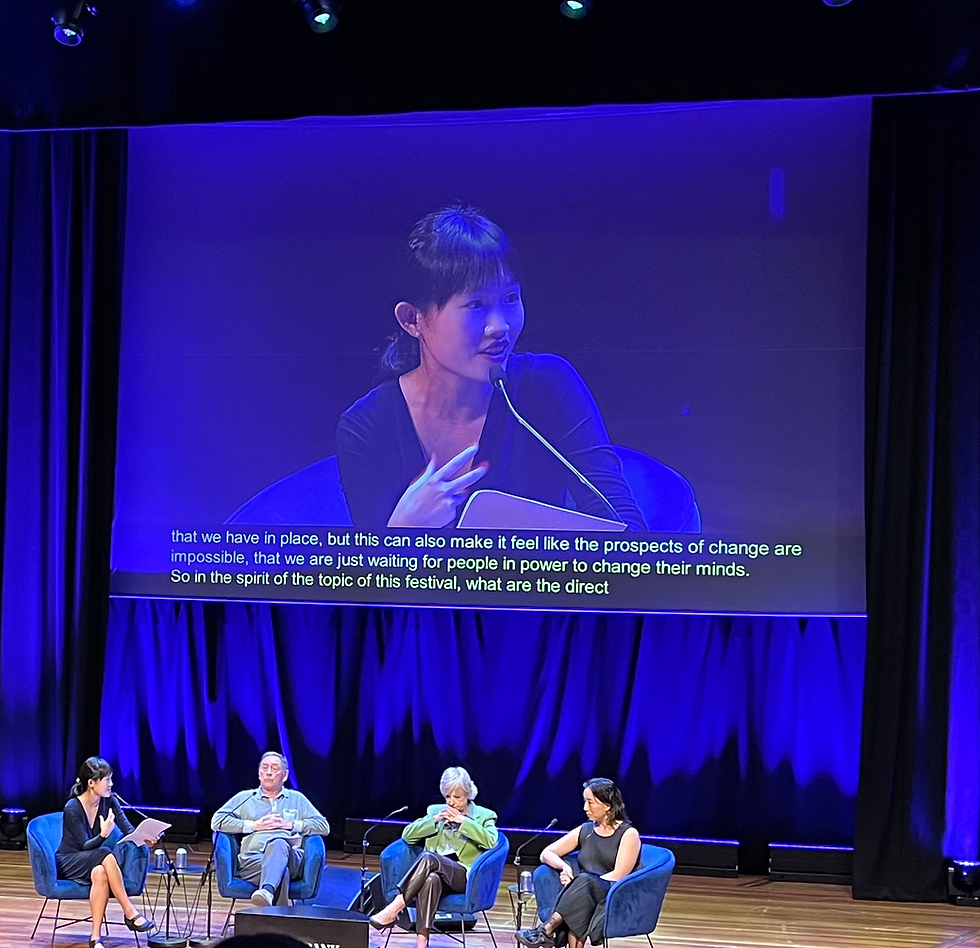
Photo by Ainhoa Aron
A few weeks ago, Southbank Centre’s Letters to the Future festival welcomed bestselling novelist R.F. Kuang to host The Future of Education panel, intended to unpack the transformative ideas redefining education in the 21st century: rising costs, shifting labour markets, the use of artificial intelligence…
For centuries, universities and colleges have been hailed as proponents of innovation, intellectual freedom and social mobility. But what becomes of these tenets of collegiate ideals when pursuing one’s education becomes antithetical to one’s career aspirations, or no longer aims to develop intellectual capacities, but rather harms them, or cripples one with debt and offers no way out of it?
Rebecca F. Kuang’s studies were marked by apocalyptic proclamations about the death of the academy. In light of Trump-era cuts to research funding, mass layoffs, grade inflation, instructors handing back AI-generated feedback to AI-generated work, the humanities were in a state of distress, the academy a hollow shell of what it once was. Kuang stresses, however, that the death of the academy is not novel. In fact, the academy has been dying for quite some time.
Guy Standing, economist and Professorial Research Associate at SOAS University of London, takes us back to the beginnings of education: in the Greek agora (place of assembly), leisure then went by the name ‘schole’, a shared concept wedding learning with recreation. Leisure was then a pursuit of knowledge and truth, and importantly, this quest for truth was sought out in communal spaces. The birth of university was rooted in this Greek tradition of socratic, dialogical learning - from which the infamous Oxford tutorial takes inspiration. Since the Greek agora popularized the communal learning environment, education has been enclosed, privatised, and corrupted into a machine of social control. First came the enclosure of the commons, then the privatisation, commodification, and financialisation of education. Education as a human capital factory system was accelerated by Margaret Thatcher, ‘bless her heart (if she had one)’, Standing quips, to the delight of Elizabeth Hall. Thatcher, and then Peter Mandelson in 1998, oriented the curriculum to the labour market, linking private equity to education. When private equity is linked to education, and EdTech is dominantly used in education (in private equity’s interest), commerce dictates who is taught what. Commerce and, most concerningly, those who command it: plutocrats. Because EdTech is, lest we forget, an instrument of ideological bias. Instead of education as an emancipatory project, to increase human intellect and capacity, education is then used as a machine of social control, to dish out superiority complexes, to justify why one person is more suited to a job than another, and to limit human capacity so that one small group of people may rise above the rest, at the expanse of the rest, at the expanse of humanity.
Standing declares an emergency in the world of education, affecting all in and outside of this world. His call to action? First, to rescue education for education’s sake. This means decommercialising the academic community, getting rid of tuition, debt, and profit-making: ‘we have to look at education fundamentally afresh; it is an absurdity that only 40% of tuition is spent on tuition.’ Most of tuition, in fact, goes to administrators, for profit.
Another problem that has arisen from losing education as a commons, Standing adds, is the instability of teaching as a job: 75% of academics are on short-term contracts. This is a result of the privatisation of ideas, patent-making, selling to corporations - essentially, gate-keeping. Standing calls for a turn to ‘slow education’: lower costs, de-intensify schooling by foregoing what he has called ‘examinitus’, and make education fun. Young people loathe school because they fear failure. Finland scores highest in many educational departments, because students there are barely forced into any big tests. Education, if it is to survive, needs to turn back to its Greek values: community, dialogue, leisure.
‘That’s my short answer’, Standing chuckles.
‘I guess the short-term solution for young people is to move to Finland,’ adds Kuang.
Rose Luckin, Professor Emerita at UCL and leading expert on AI in education, flavours her optimism on the future of education with a similar warning that we recognize and act upon the seriousness of the situation. Luckin stresses that, like Kuang, she still believes in ‘the power of the classroom’, while agreeing with Standing that education must undergo great changes if it is to survive. These changes, she suggests, ought to revolve around the ways in which we use and value AI over human intelligence. ‘We only treasure what we measure,’ she states, ‘and we measure only small bits of human intelligence.’ And here, these bits tend to be those which can be reduced to commodities. Here is a moment in time for a new Enlightenment, Luckin declares, not an AI-renaissance but an Enlightenment that might push for the radical prioritization of tacit human, emotional intelligence. Humans being capable, after all, of an affective, somatic intelligence still well out of the reach of AI agents, who may mimic social intelligence but are not intersubjectively attuned as humans are.
Luckin warns of the steep decline in deep reading OECP scores have seen around the world since the rise of AI in education. Since AI is being used to get an output, rather than to teach one how to solve for X, recent studies have seen an explosion of ‘cognitive off-loading’. Cognitive surrender even, Luckin claims. Misinformation is spreading and people are becoming more naive, not questioning what is presented to them. Her solution? A change in pedagogical practices. If we are to have tests, which Standing heavily opposes, then let them be testing students’ understanding and pressuring critical thinking, so as to preserve the small, but beautiful and unspeakably invaluable remains of intelligence as yet unattainable to machines of our creation.
Lastly, Xine Yao, Associate Professor in American Literature and co-director of the queer studies network at UCL, speaks to the optimistic turn of universities’ humanities departments to dynamic pedagogies, in the midst of generative AI’s terrifying growth within educational institutions. Yao begins by introducing herself as someone who came from an English colony to the heart of the Empire to teach English literature to the English. An honourable profession when literature has historically been used by this empire to subjugate its colonies, teaching obedience and inferiority. But the humanities have, in recent decades, radically transformed from studies venerating the past to teaching literature’s regenerative potential. Dynamic pedagogies asking students to engage with the past, seek out voices that had been stamped out with time, erased from the history books, and bring them out the light in innovative ways, are a prime example of the potential educational institutions still have in promoting empathy, coexistence, and cultural enrichment. At a time when the UK’s power is waning and its empire is no more, Yao sees the humanities as the UK’s renewable resource, an invaluable promise of mutual enrichment.
‘Wow, Xine, from your lips to Andy Burnham’s,’ R.F. Kuang replies to these potent declarations.
This plea is followed by concluding calls-to-action from our three panellists, Standing asking the government to set up a commission to rescue education from the education business; Luckin wanting an emergency response, the mass-forming of coalitions to put humans first in education rather than AI; and Yao stressing that in the ecosystem of change, everyone must recognize that wherever they are, they can do something to stop this tidal wave, and that small changes in one department are interconnected to change in others.
It is not the general use of AI in education that poses a threat to humanity, rather the ubiquitous and unquestioning assent to generative AI’s unreliable, soulless, and environmentally damning results. We must get together, learn from each other, teach ourselves to prioritize our own intellectual capacities, our clever, clever ways of working through problems creatively. We mustn’t let the future generations rot in a bed we’ve still been lucky enough to escape occasionally. We mustn’t let ourselves despair, though despair does seem to be hanging in the air and seeping into our bones these days, because education relies on hope. That is what curiosity is: to walk into Elizabeth Hall, hoping to learn something from another person.
Edited by Ainhoa Aron, Literature Editor


Comments