Introducing Paul’s Daughter

Paul’s Daughter is the musical world of Izzy Searle, a London-based artist whose songs sit somewhere between gothic introspection, guitar-led melancholy, and pop hooks that feel both bruised and romantic. Formed over the past three years, the project grew out of a winding path through childhood bands, early studio experiments, and a formative stint in Los Angeles that helped sharpen her instincts, even if the music itself stayed unreleased.
Since returning to the UK, Paul’s Daughter has slowly come into focus as a fully realised universe. Drawing from Victorian imagery, analogue textures, and an eye for striking visuals, Izzy treats songwriting as both emotional excavation and world-building exercise. Her debut single ‘Telephone’, released independently in 2023, introduced a voice unafraid of vulnerability, while her newer material leans deeper into darker tones, sharper lyricism, and a clearer sense of self.
Ahead of her appearance at Abbie McCarthy’s Future Karma at The Lower Third, we spoke to Izzy about the unlikely origin of her artist name, navigating early industry experiences, blending music with visual art, and learning to trust her instincts as Paul’s Daughter continues to take shape.
For people discovering Paul’s Daughter for the first time, how would you describe the project and what it means to you?
Paul’s Daughter has existed for about three years now, since I found the name and started taking music seriously in a professional way.
The name itself is completely random, which I think says a lot about me. Paul was the studio manager at the first recording studio I ever worked in. My first producer Danny and I were making music in this metal box of a room inside a warehouse in Milton Keynes. We’d be there for ten hour days, completely delirious. I’d empty the vending machine of Fosters and snacks, and we were desperately trying to figure out an identity for the music. Danny and I were very similar and really pushed each other creatively, and it was such a formative experience.
Long story short, we used to break into Paul’s office where all the vending machine stock was. If anyone caught us, I’d run around screaming, “I’m Paul’s daughter.” I basically built my entire identity around this random man who probably has no idea I exist and is just living his life.
Musically, I had a strange route in. I was in bands my whole childhood. I went to a Saturday music school at my local comprehensive, where we learned loads of instruments and played in bands. When I was around twelve, we’d do little shows for parents at places like the Troubadour, which is wild looking back. I was mainly a lead guitarist and never really a vocalist. I sang a bit, but my voice was high-pitched and shaky, and I loved hiding behind my guitar. It felt safe.
My band fell apart when I was fifteen, and by seventeen I wanted to start again.

How did Paul’s Daughter become a solo project?
I went to an all-girls school and hated it. I remember sitting in art class and going on this dodgy website called Bandmix, which is basically Tinder for bands. You’re either looking to join a band or recruit someone. I met this random guy, went to his house, we became super close and recorded loads of raw teenage demos that somehow got picked up by a pop management team.
They flew me to LA for two months split over 2022, right after I turned nineteen. It was completely surreal. I went once in June, then again in September, mostly on my own. My mum came out briefly the first time and saw what I’d been working on, which I think was the first moment she really understood what I was trying to do. We drove down the Pacific Coast Highway blasting the first demo I had made there. It was a memory I will hold onto forever. I think it was the first time I fully believed in myself too.
I’d never done sessions in London and had no idea how they worked. In LA, everything was so fast-paced. I’d write one song per session. I worked with some incredible producers, including Stint, who I’m still in touch with and hope to work with again someday. We did a week together and he was perfect for me – pop-leaning, emo, guitar-driven, nostalgic but weird. I didn’t really know what I was doing, and he brought everything to life.
I came back to London with all these demos I loved which were very Californian grunge but couldn’t release them at the time because they were too expensive. I also didn’t really understand social media or TikTok at the time, which I regret. I hope to re-record those songs one day because I still love them.
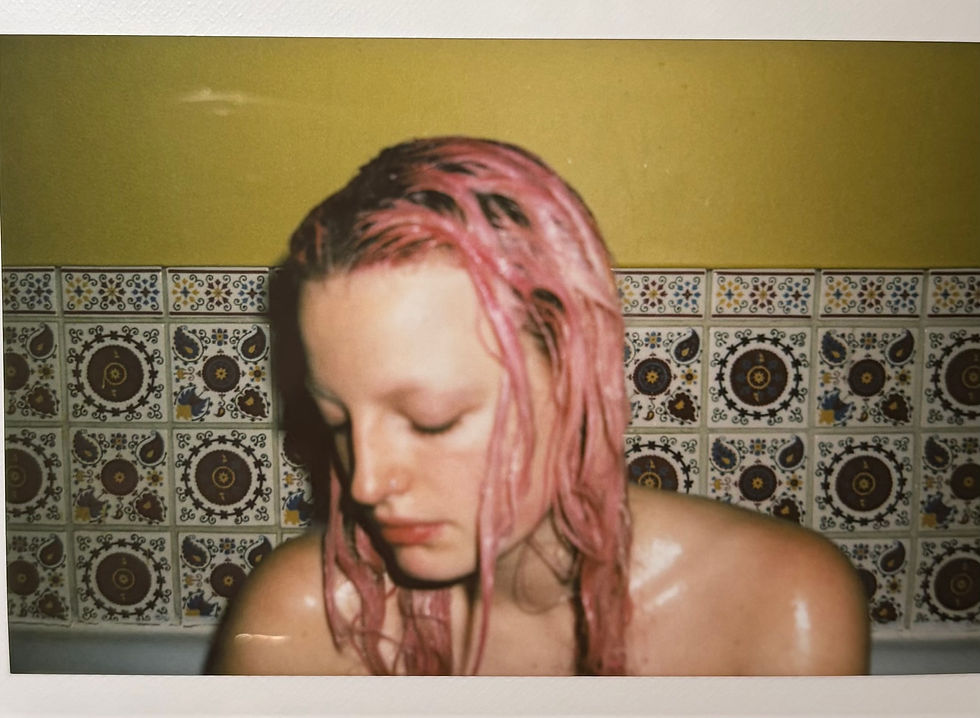
Now, Paul’s Daughter feels like everything I am in one place: gothic, introspective, Victorian punk. I love bright colours, Polaroids, Twin Peaks, 70s visuals and weird sci-fi Huxley-like texts. Seeing followers with niche references I love as their profile pictures makes me feel like the right people are finding it. When someone commented that they’d seen me at an Ethel Cain show, I thought, “Okay, the niche is being discovered.” That sense of community really matters to me.
You released ‘Telephone’ last October 2023 – what was happening in your life when you wrote it, and how does it feel to have it out in the world now?
I met producer Charlie Pitts who is incredible and really understood me early on. We made ‘Telephone’ together, which I released independently through DistroKid. It did get some nice traction, but I don’t think it fully represented me. At the time, I didn’t really know who I was as an artist.

I was in my second year at Camberwell College of Arts, still piecing things together. Paul’s Daughter existed more as an idea than a fully formed project. Since then, I’ve taken so much from my LA and London experiences and poured it into the singles I’ve just made, which feels like a gothic commentary on Hollywood… almost a Londonification of that American world.
A big part of Paul’s Daughter is witty lyricism paired with visuals that go beyond aesthetics. I was really interested in the rise of British inspired visuals in America and vice versa, especially Addison Rae’s video ‘Headphones on’ being shot outside an Iceland supermarket. That clash of American pop culture and British mundanity fascinated me. I love how British and American cultures romanticise each other visually, and I want to play with that tension.
What was the message behind ‘Telephone’?
It was very personal. I was dealing with relationship issues, jealousy, and feeling like people around me were seeing me differently because I wanted different things. I didn’t feel secure in myself or my craft, and that was scary.
The song became an ode to that insecurity, dressed up with a gentle folk guitar and simple melody. I rarely listen to it now because it feels very naked. I struggled with not being able to choose who heard it. You never get the exact audience you imagine.
Over time, I learned to take power from that feeling. Even if I don’t fully know who I am yet, I’m trying. I put something honest out there, and I’m proud of myself for doing that. My identity will keep changing, and that’s okay.
You’re playing Abbie McCarthy’s Future Karma at The Lower Third on February 4th. What can people expect from a Paul’s Daughter live set?
I’ve only recently put together a full band. My last show was a headline at the Sebright Arms, and I’d met the band two days earlier. We rehearsed intensely at Premises Studios, and it was my first time using in-ears and having full production.
I get terrible stage fright, but I also thrive under pressure. There might be some dry humour or accidental stand-up moments, but I don’t like talking too much between songs. I want people to take what they want from the music.
The songs are fun, guitar-heavy, and rocky. I have this stripy carpet my management got me that I put under my feet on stage which makes me feel at home. My pre-show ritual is whiskey with hot water, lemon, and honey. It helps my voice and my nerves.
I’m trying to focus less on impressing industry people and more on becoming comfortable as a performer. I think I’ll feel most at home once the gigs become more fan-led.
Are you currently signed to a label?
No, I’m releasing independently through distributors for now. The idea of a big record deal would scare me at this stage. Creative freedom matters more than anything. World-building is my priority, and I’m trying to think long-term. Financial security is tempting, but longevity feels more important.

How did music first enter your life?
I was obsessed with Hannah Montana as a kid – to the point where I went bleach blonde with a fringe. Probably not a coincidence.
When I was four, my parents gave me a blue plastic guitar. Apparently, I grabbed it naked, stood at the top of the stairs, and announced, “Mum, Dad, I’m going to be a rockstar.” I went to a very conservative all-girls primary school that pushed orchestra instruments, so I strummed my violin and turned it on its side until my parents finally gave me a real guitar. They even let me join the orchestra with it.
Saturday rock school introduced me to heavy rock and metal. My first bands were all metal, and I played bass and guitar.
What does your songwriting process look like now?
It usually happens without intention. I like letting songs sit for months before understanding what they mean. We jam together to find chords, then refine lyrics later.
My producer Hugo Silvani is incredible musically, and my co-writer Benjamin Francis Leftwich really challenges me lyrically. They are both amazing and I owe most of my musical security to them. We always do an acoustic test at the end of a session which is just me and a guitar. If it works stripped back, it’ll work however it’s produced. That’s essential for me.
You also work as a visual artist, taking on commissioned pieces. How do your visual work and your music inform each other, if at all?
My mum always made me watch music videos with songs – Bowie, Pet Shop Boys, Guns N’ Roses. That’s how I experience music. I’m an extremely visual person.
At Camberwell, I struggled to connect art and music because I didn’t want the visuals to feel like branding. Painting the cover for ‘Telephone’ changed that. It helped me realise I could let everything coexist.
I love the idea of leaving paintings around London with demo CDs hidden in the back, letting people take them home. I’m not precious about it commercially, it feels like my soul. Painting gives me balance and stops me burning out.
Do you ever visualise songs as paintings?
All the time. I’ll play demos and paint to them. Seeing a song as colours helps me understand how to present it visually and emotionally. It’s incredibly grounding.
What’s coming next for Paul’s Daughter?
I’m releasing one single this month and hopefully another in February leading into an EP. They’re darker, very 90s trip-hop inspired, with machine drums and heavy hooks.
I’m finally writing with intention and substance. My collaborators have transformed everything. Ben brings this beautifully odd, emo perspective, and Hugo brings that nostalgic guitar sound I’ve always chased. Us three together create the incredible writing team I've always dreamed of.
Right now, I’m focused on building a world that feels completely true to me. I want people to reference me, not the other way around. I want to explore femininity, power, and confidence on my own terms, without feeling like I have to over-sexualise myself to exist in this industry.
My dream venues are the Roundhouse and Red Rocks. I’d love to collaborate with Ethel Cain and Radiohead musically, or Jacob Slater from Wunderhorse on a vocal level. Mostly, I just want to keep building something honest and lasting. Listen to Paul's Daughter on Spotify, Apple Music, and SoundCloud, and follow her on Instagram.


Comments